
The purchase only makes financial sense when your process needs drier air than a refrigerated dryer can provide, or when moisture damage costs more than treatment. By comparing pressure dew point, purge-air loss, sizing, maintenance, and supplier support, you can decide whether desiccant drying is necessary or an avoidable expense.
Key takeaways
- Choose desiccant drying when you need a pressure dew point below 0°C.
- Use refrigerated drying when +3°C PDP meets your process requirements.
- Size the dryer for peak airflow, inlet conditions and future demand.
- Compare purge-air loss, heater energy, maintenance and service costs.
Start with the pressure dew point, not the brand
Pressure dew point (PDP) determines whether you need desiccant drying. If your air stays indoors above freezing and +3°C PDP is acceptable, a refrigerated dryer is usually the lower-cost choice.
Choose a desiccant dryer when the process needs −20°C to −40°C PDP, outdoor pipework can fall below 0°C, or moisture causes product rejects, corrosion, contamination, or costly stoppages. Under ISO 8573-1, Class 4 allows ≤+3°C, Class 3 requires ≤−20°C, Class 2 requires ≤−40°C, and Class 1 requires ≤−70°C.
| Option | Typical result | Best fit |
|---|---|---|
| Refrigerated dryer | About +3°C PDP | Indoor workshops and general factory air |
| Desiccant dryer | About −40°C PDP; special systems reach −70°C | Cold lines, moisture-sensitive processes, ISO Class 2 or Class 1 air |
| Aftercooler, separator, and drains | Removes liquid water, not vapour to a low PDP | Basic protection where dry air is not a process requirement |
An atlas copco desiccant dryer for small businesses becomes worth buying when the cost of wet air exceeds its purge-air, power, maintenance, and capacity costs.
A heatless unit consumes part of the dried air—often about 15–20% at rated conditions—to regenerate its saturated desiccant bed, so a 100 m³/h compressor will not deliver 100 m³/h for production after that loss.
- Specify the required PDP and ISO 8573-1 water class before comparing brands.
- Price the compressor capacity needed to cover purge air, plus desiccant, valves, filters, drains, and downtime.
- Reject the purchase if +3°C PDP meets the process and all air lines remain above freezing.
- Check automatic-drain alarms and service access; a failed-open drain wastes air, while a failed-closed drain can flood and damage the desiccant beds.
Compare desiccant, refrigerated, membrane, and basic water removal
A refrigerated dryer is usually the sensible choice for indoor plant air that only needs a +3°C pressure dew point. Choose desiccant when air must stay dry below freezing, moisture-sensitive products cannot tolerate condensation, or corrosion and rejects cost more than purge air and maintenance.
| Option | Dryness and temperature limits | Energy, price, maintenance, and fit |
|---|---|---|
| Desiccant | About −40°C PDP; special systems reach about −70°C. Works for cold lines and demanding processes. | Higher purchase cost. Heatless models consume purge air; heated or blower-purge models reduce purge but use electricity. Replace desiccant, service valves, drains, and prefilters. Uses include powders, pharmaceuticals, electronics, paint, and outdoor pneumatics. |
| Refrigerated | About +3°C PDP. Keep the air and pipework above freezing. | Lower purchase and operating cost for general plant air. Uses electricity for refrigeration and needs condenser cleaning, drains, and filter service. Suits workshops, indoor pneumatic tools, and ordinary automation. |
| Membrane | Can provide dry air without a refrigeration circuit, but flow and achievable PDP depend on membrane size and purge demand. | Compact and quiet, with no moving parts, but purge-air loss can be substantial. Replace prefilters and use it for point-of-use instruments, analyzers, or small air demands. |
| Basic water removal | Aftercoolers, separators, and automatic drains remove liquid water, not water vapour; they do not provide a controlled low PDP. | Lowest cost and maintenance, but a failed-open drain wastes air while a failed-closed drain sends water downstream. Use as protection before any dryer, not as a substitute. |
For an Atlas Copco air dryer for small business, compare compressor capacity, purge loss, pressure drop, electricity, desiccant replacement, and downtime—not purchase price alone. Check the actual desiccant air dryer uses against your process before paying for dryness you do not need.
Size the dryer for real demand and protect the beds
Use the worst credible operating day, not the compressor nameplate, to size the dryer. Record actual inlet pressure, peak and average flow, inlet temperature, ambient temperature, required pressure dew point (PDP), flow variation, and electrical supply. Include Bangalore’s hot, humid summer and monsoon conditions if the installation is there.
1. Remove liquid water before the desiccant beds. Use an aftercooler, water separator, reliable automatic drain, and wet receiver, followed by the manufacturer-specified coalescing prefilter. A drain that fails closed sends water into the beds; one that fails open wastes compressed air. Provide test access, alarms where available, and a documented drain-service interval.
2. Protect the outlet with the specified particulate after-filter. Add activated-carbon filtration only when oil vapour removal is required; extra filters add pressure drop and maintenance. Install the dryer indoors or under weather protection, with ventilation, clearance for valve and desiccant service, level pipework, and drains that cannot flood or back up.
3. Ask for a selection calculation at your actual conditions, including the peak flow and lowest operating pressure. Check the correction factors for inlet temperature, pressure, PDP, and regeneration method. A heatless unit using 15–20% purge at rated conditions turns 100 m³/h into less usable air, before pressure drop and demand peaks are considered.
Confirm that the compressor still covers production demand after purge loss. If it does not, the dryer is undersized even when its catalogue flow appears adequate. Test dew point at the point of use after stabilisation, not only at the dryer outlet.
Calculate the full operating cost before you approve the purchase
Approve the dryer only after converting every loss into an annual cost. For a heatless unit, calculate purge air as 15–20% of rated flow at rated conditions, then price the extra compressor capacity and electricity needed to replace it.
Recalculate using actual pressure, temperature, flow profile, and worst credible conditions; a nameplate flow figure is not enough.
Use this comparison:
| Option | Count in the life-cycle cost | Cost that can change the decision |
|---|---|---|
| Heatless desiccant | Purge air, compressor energy, desiccant, valves, drains, filters, and service labour | Low purchase price can be outweighed by 15–20% purge loss |
| Heated-regeneration | Heater electricity, controls, purge allowance, desiccant, and maintenance | Lower air loss can cost more than the saved compressor power |
| Blower-purge | Blower electricity, controls, service, desiccant, and minimal purge air | Higher capital cost needs many operating hours to pay back |
| Refrigerated | Electrical consumption, drains, filters, and moisture-related production losses | Lower cost for about +3°C PDP indoors above freezing, but inadequate dryness can create rejects or corrosion |
Add pressure-drop cost at commissioning and at filter replacement intervals. Include the dryer, prefilters, afterfilters, valves, and piping at both clean and end-of-life pressure drop; raising compressor pressure to recover lost plant pressure increases energy use.
Then price downtime: one failed valve, saturated bed, blocked drain, or wet-air incident can stop production. Compare that exposure with planned desiccant replacement, drain and valve maintenance, filtration, and the supplier’s service response.
A desiccant dryer earns its place when the avoided cost of moisture damage and downtime exceeds these recurring costs over its working life.
Verify the proposal and the support behind it
Do not approve a quote that shows only an Atlas Copco model and a nominal flow rate.
Ask the desiccant dryer supplier in Bangalore to document the selection basis for your site: summer and monsoon inlet temperature, actual compressor discharge pressure, flow profile, required pressure dew point (PDP), electrical supply, condensate-drain arrangement, and service response time.
1. Before installation, request the selection calculation, including correction factors for inlet temperature, operating pressure, required PDP, and worst credible flow. It must state purge-air consumption, regeneration method, pressure drop, usable outlet flow, and the extra compressor capacity required. A 100 m³/h nameplate does not mean 100 m³/h reaches your process after purge.
2. Require a filtration and drainage schedule. It should identify the upstream water separator, coalescing filter, oil-removal stage where needed, afterfilter, automatic-drain type, drain test access, alarm function, and maintenance interval. A failed-open drain wastes air; a failed-closed drain sends liquid into the desiccant bed.
3. Put commissioning acceptance in writing: inlet conditions, outlet PDP, flow, pressure drop, purge percentage, alarms, and the test instrument’s calibration details. Do not accept “running” as proof of performance.
4. Ask for named service contacts, response times, critical spare-part availability, desiccant replacement intervals, valve and drain service procedures, and a written warranty boundary. Raya Virra Sales should be able to explain which readings technicians will record during handover and scheduled visits, not merely supply the dryer.
Related products
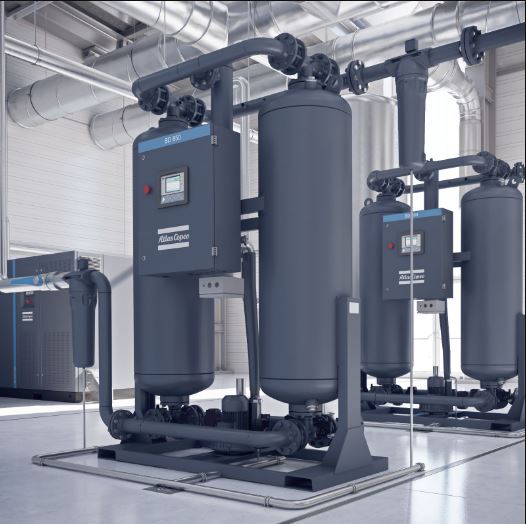 | Desiccant Type Air Dryer Dry and clean compressed air is essential for a broad range of industrial applications. View product → |
 | Refrigerated Air Dryer The air that leaves a compressor reaches 100% humidity. Aftercoolers and drains are the first line of defense against water in your system. View product → |
Frequently asked questions
When is an Atlas Copco desiccant dryer worth buying for a small business?
It is worth considering when your process needs a pressure dew point below 0°C, such as preventing ice or protecting moisture-sensitive equipment. If +3°C PDP is sufficient, a refrigerated dryer usually costs less to operate and purchase.
How does a desiccant dryer compare with refrigerated, membrane and basic water-removal systems?
Desiccant dryers provide very low pressure dew points, refrigerated dryers suit general indoor compressed-air use, membrane dryers suit smaller point-of-use applications, and separators or drains remove bulk liquid water without drying the air fully.
How should you size a desiccant dryer for a small business?
Base the selection on peak air demand, inlet pressure, inlet temperature, required PDP and future capacity. Check purge-air consumption and protect the desiccant beds with effective upstream filtration and liquid-water removal.
What operating costs should you compare before buying a desiccant dryer?
Compare purchase price, installation, purge-air loss, heater electricity, filter replacement, desiccant replacement, drain maintenance, pressure drop and service costs over the expected operating life.
What should you verify with an Atlas Copco air dryer supplier in Bangalore?
Request the rated flow, pressure dew point, inlet limits, pressure drop, purge percentage, power demand, filter specification, warranty terms, commissioning scope, service response and spare-parts availability in Bangalore.
Related product
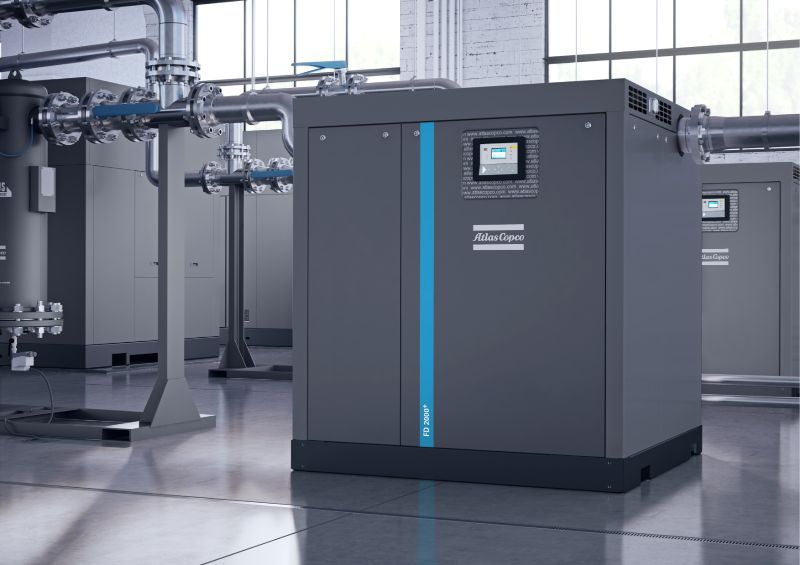 | Refrigerated Air Dryer F6 - 400 The air that leaves a compressor reaches 100% humidity. Aftercoolers and drains are the first line of defense against water in your system. |