
An Atlas Copco IPM compressor can supply a PSA oxygen generator, but the answer depends on the exact compressor configuration and the oxygen generator’s written feed-air specification. You will be able to test oil risk, capacity, pressure, treatment, controls, and site conditions before approving a system.
Key takeaways
- IPM motor technology does not make compressed air oil-free.
- Use the oxygen generator maker’s inlet pressure, flow and purity limits.
- Size filtration and drying for the measured air-quality requirement.
- Approve the compressor, receiver, controls and treatment train as one system.
An IPM motor does not make compressor air oil-free
An Atlas Copco IPM compressor can supply a PSA oxygen generator only when the generator maker accepts oil-injected feed air and the complete treatment train meets its measured inlet limits. IPM means interior permanent-magnet motor technology; it does not define the compressor’s air-purity class.
| Configuration | What it provides | Suitable position |
|---|---|---|
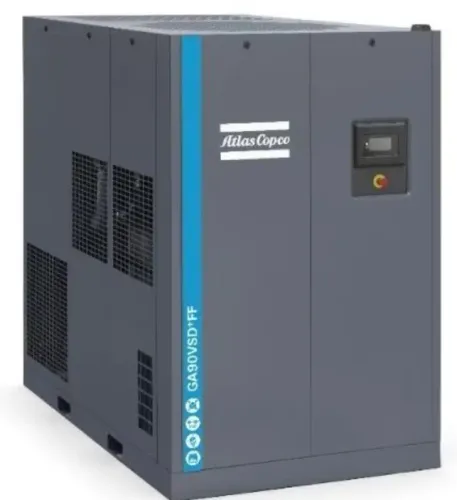
| GA 7-75 VSD iPM | Oil-injected screw compression with variable-speed motor efficiency | Atmospheric-air side, before treatment |
| IPM air compressor applications | Efficient response to changing demand, not guaranteed oil-free air | Feed-air source only after specification and treatment review |
| Certified oil-free compressor | Compression designed and certified for an oil-free-air requirement | Use when the PSA specification demands certified oil-free air |
The GA 7-75 VSD iPM discharge can contain oil aerosol, oil vapour, degraded oil, particles, and moisture. Those contaminants can foul molecular sieve and damage valves. Put this compressor on the atmospheric-air side of the PSA system, never on the oxygen-product outlet, unless it is specifically engineered, cleaned, tested, and approved for oxygen service.
If the specification calls for certified oil-free air, choose a compressor designed and certified for that requirement. Downstream filters do not become an equivalent substitute merely because they are installed.
Motor efficiency remains valuable when oxygen demand varies because variable-speed control can reduce unloaded or throttling losses, but it cannot replace air-purity verification at the PSA inlet.
The practical answer to “atlas copco ipm compressor oxygen generator” is therefore conditional: approve the exact model only against the generator maker’s written oil, particle, water, and sampling requirements.
Get the oxygen generator’s inlet specification before sizing the compressor
A compressor sized from motor kW or receiver volume can still fail to supply the oxygen generator. Obtain the manufacturer’s written inlet datasheet before making an oxygen generator compressor selection.
Request these figures:
- Oxygen capacity in Nm³/h or m³/h, guaranteed oxygen purity at that flow, and feed-air consumption
- Required inlet pressure in bar(g), permitted pressure range, and allowed pressure fluctuation
- Maximum inlet temperature, relative humidity, and pressure dew point
- Residual-oil limit and particle class
- Test standard, measurement conditions, and the guarantee curve linking air flow, pressure, purity, and oxygen output
| Number | How it determines sizing | Failure if omitted |
|---|---|---|
| Oxygen flow and feed-air consumption | Sets the compressor’s required FAD | Output or purity falls below guarantee |
| Inlet pressure and permitted range | Sets discharge-pressure and control requirements | Treatment losses push pressure below the PSA minimum |
| Temperature, humidity and altitude | Sets derating and dryer duty | Hot, thin intake air reduces delivered capacity |
| Oil, particles and dew point | Sets treatment equipment and pressure drop | Contamination or wet air damages molecular sieve |
Do not assume a fixed air-to-oxygen ratio. PSA systems commonly produce about 90–95% oxygen, but pressure, flow, cycle settings, temperature, and sieve condition change both purity and output.
Select the compressor by FAD at the specified discharge pressure and test conditions, then add generator demand, leakage, purge or regeneration air, filter and dryer drop, piping loss, altitude effects, and hot-ambient derating. Compare suppliers only when their test standards and measurement conditions match.
Build the treatment train around the actual air-quality limit
The treatment train must meet the oxygen generator supplier’s limits at the PSA inlet, not merely produce clean-looking compressor discharge air. ISO 8573-1 separates particles, water, and oil into three independent classes; “Class 1” is incomplete unless it names all three.
Obtain the required particle class, pressure dew point, total-oil limit, and sampling location in writing.
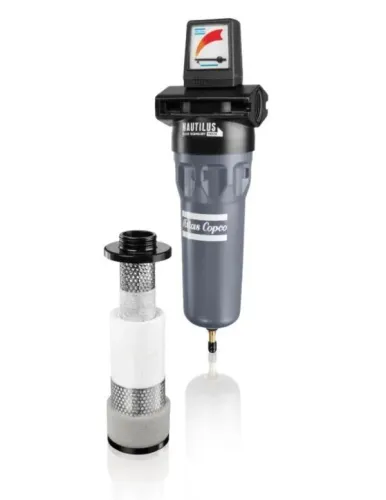
1. Install a water separator and reliable automatic drains immediately after compression. Add particulate prefiltration, coalescing filtration, an oil-vapour removal stage, a correctly sized dryer, and a final filter close to the PSA inlet when the supplier’s limits require them.
2. Size every filter for actual flow and pressure. Check differential pressure across each element, confirm drain operation under load, record element replacement intervals, and monitor treated air at the generator inlet rather than at the compressor outlet.
3. Match the dryer’s pressure-dew-point rating to the specified operating pressure and flow. An unnecessarily restrictive dryer raises compressor discharge pressure, increases energy use, and reduces available PSA inlet pressure.
Oil aerosol, oil vapour, and degraded oil can foul molecular sieve, reduce adsorption performance, increase maintenance, and create an oxygen-safety concern. Liquid water, desiccant dust, or a failed drain can damage valves and contaminate the skid. Where the specification lists carbon monoxide or hydrocarbons, add explicit control and testing for them.
An Atlas Copco air compressor for an oxygen generator in Tumkur is suitable only when this complete train achieves the supplier’s measured limits.
Match pressure, flow, receiver volume, and controls to the PSA cycle
Set discharge pressure from the PSA manufacturer’s stated minimum and maximum inlet pressure. Choose enough margin to cover the dryer, filters, valves, and piping losses, but do not routinely exceed the generator’s required pressure. Extra pressure preserves flow after losses; it also increases compression energy, discharge heat, dryer load, and filter pressure drop.
Size the receiver from peak cycle demand, permitted pressure band, compressor control method, and required hold-up time. It must supply short PSA-cycle changes, dampen pressure swings, and reduce starts—not merely store air. Calculate useful receiver volume between the compressor’s load and unload pressures.
An IPM variable-speed compressor reduces unloaded or throttling losses as oxygen demand changes. It does not prevent low-load cycling by itself. Match compressor turndown with receiver controls, PSA sequencing, purge demand, minimum-run times, and high- and low-pressure alarms.
Check these conditions before approving an atlas copco air compressor in tumkur:
- Confirm elevation and apply the stated pressure derating to both compressor and dryer.
- Use the summer inlet temperature for capacity, cooling, and dryer selection.
- Verify ventilation, cooling arrangement, electrical voltage, phase, and voltage under load.
- Leave space for filter, dryer, and receiver service access.
- Confirm the IPM air compressor applications match the PSA’s operating hours and variable demand.
- Measure pressure and flow at the PSA inlet, not only at the compressor outlet.
Approve the complete installation, not the compressor nameplate
Approve the complete installation only when measured results at the oxygen generator’s stated operating point meet its written guarantee. The “Atlas Copco IPM compressor oxygen generator” decision is a package decision, not a nameplate decision.
- Record compressor discharge pressure and FAD, treated-air pressure and flow at the PSA inlet, pressure-dew point, particles, total oil, specified vapour contaminants, oxygen purity, oxygen flow, and electrical power.
- Inspect piping diameter and routing, filter differential pressure, automatic-drain discharge, receiver-pressure stability, ventilation, intake temperature, and voltage and phase under load.
- Obtain the exact model, lubricant arrangement, certified outlet-air quality, compressor and dryer derating calculations, filter specifications, sampling plan, and element replacement schedule.
Compare the readings with the oxygen-generator maker’s guarantees, including permitted pressure fluctuation and purity at the tested flow.
| Checkpoint | Acceptance comparison | Failure consequence |
|---|---|---|
| Compressor and treated air | Pressure, FAD, flow, dew point, particles, oil and vapours meet the inlet specification | PSA capacity or sieve life falls |
| Oxygen product | Purity and flow meet the guarantee at that pressure and air demand | The promised output is unproven |
| Site and electrical supply | Ventilation, intake temperature, piping, drains and loaded voltage match the design basis | Heat, restriction or voltage drop reduces delivery |
For an Atlas Copco air compressor for oxygen generator in Tumkur, Raya Virra Sales can be useful when the quotation assigns commissioning measurements and maintenance responsibilities for the complete air source, treatment, receiver and controls. Approve an Atlas Copco air compressor in Tumkur only when every result meets the generator specification.
Related product
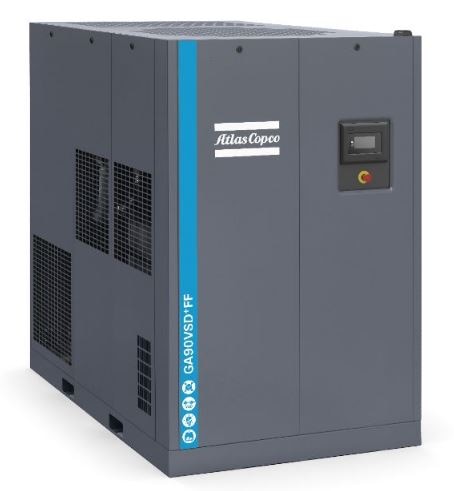 | Variable Speed Drive Air Compressor GA7 - 75VSD iPM Atlas Copco’s GA 7-75 VSD iPM compressors feature smart drive and intelligent control for unprecedented reliability and efficiency. |
Frequently asked questions
Does an IPM motor make compressor air oil-free?
No. IPM describes the motor’s interior permanent-magnet design, not the compressor’s air-purity class. Check whether the compressor is oil-injected or oil-free and verify the delivered air quality.
What specification should you request before choosing an oxygen-generator compressor?
Request the generator maker’s inlet pressure, flow, pressure-dew-point, oil, particle and moisture limits, along with PSA cycle requirements. Use those figures to size the compressor and treatment train.
How should you match the compressor to a PSA oxygen generator?
Match free-air delivery and pressure to the PSA cycle, then size the receiver, dryer, filters and controls for demand swings, regeneration and required inlet quality.
Is the compressor nameplate enough to approve an oxygen-generator installation?
No. Approve the complete installation, including compressor, receiver, treatment equipment, piping, drains, controls and measured air quality at the generator inlet.