
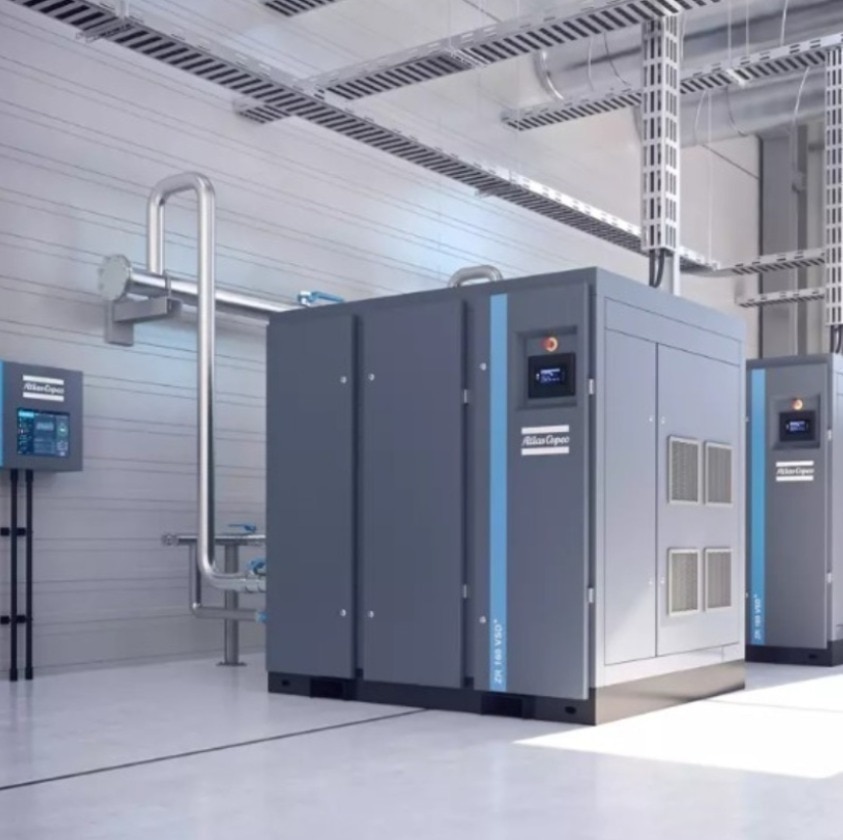
Moisture in a manufacturing air system does more than create visible condensation: it corrodes pipework, blocks pneumatic controls, damages powders, and disrupts instrument signals. By the end, you will be able to specify the required pressure dew point, compare desiccant and refrigerated drying, and judge whether an Atlas Copco system suits your Bangalore plant conditions.
Key takeaways
- Use desiccant drying when moisture can damage products, instruments, or processes.
- Choose regeneration type by purge-air cost, available heat, footprint, and dew-point demand.
- Size for inlet temperature, pressure, flow, ambient conditions, and future production capacity.
- Install filtration, drains, and oil protection because a dryer cannot fix upstream contamination.
How moisture turns into production failures
Moisture becomes a production failure when it reaches equipment, instruments, or the product. In dry compressed air manufacturing, the goal is process reliability, not air that merely looks clean.
Dry compressed air prevents:
- Corrosion inside receivers, pipework, valves, and pneumatic tools, which creates leaks and contaminates the air stream.
- Sticking pneumatic valves and actuators, causing slow movements, incomplete strokes, or unexpected machine stoppages.
- Faulty instrument-air signals when water damages sensors, positioners, or control components.
- Product contamination and coating defects, including blisters, poor adhesion, uneven finishes, and rejected batches.
- Moisture damage in powder and granule processes, where water causes clumping, blockage, or inconsistent feeding.
- Ice formation at expansion points, pressure regulators, and outdoor lines when compressed air cools below its dew point.
Define dryness with pressure dew point (PDP), not with a label such as “dry air.” ISO 8573-1 classifies water content by PDP: Class 4 allows +3°C, Class 3 allows −20°C, Class 2 allows −40°C, and Class 1 allows −70°C or lower.
Select the class from the process requirement, the lowest temperature reached by exposed piping, and the consequence of moisture breakthrough.
Bangalore’s monsoon humidity does not set the PDP by itself. Confirm inlet temperature, operating pressure, peak flow, and the coldest downstream location. A dryer selected from catalogue flow alone can fail at actual conditions; filtration and drainage also remain necessary when the process needs low oil or particulate levels.
These are the practical industrial air dryer benefits to verify before purchase.
When a desiccant dryer is worth the extra cost
Select adsorption drying when your specified pressure dew point (PDP) is about −40°C or lower, or when moisture could freeze, corrode equipment, contaminate products, or disable pneumatic controls. Choose a refrigerated dryer when the required PDP is around +3°C to +7°C and every pipe, valve and process connection stays above that dew point.
| Dryer type | Typical pressure dew point | Cost and operating trade-off | Suitable use |
|---|---|---|---|
| Refrigerated | About +3°C to +7°C | Lower purchase cost, energy use and maintenance; no regeneration purge | Indoor general manufacturing air with no low-temperature exposure |
| Desiccant adsorption | About −40°C; demanding systems may require −70°C | Higher capital cost; regeneration energy, pressure drop and purge-air loss | Instrument air, exposed pipework, critical controls and moisture-sensitive processes |
A refrigerated dryer is the wrong choice when a cold outdoor line can reach the dew point. Liquid water or ice can then block valves and damage instruments even if the compressor room air looks dry.
Bangalore monsoon humidity does not decide the dryer type by itself. Use the required PDP, lowest pipe temperature, inlet temperature, operating pressure, maximum flow and consequence of moisture entry. Those factors determine the desiccant dryer benefits in Bangalore, not climate alone.
To judge industrial air dryer benefits, include prefilters, drains, receiver placement and compressor sequencing in the calculation. A heatless unit can consume roughly 15–20% of rated dryer flow as purge air, while excessive pressure drop can force higher compressor discharge pressure. Adsorption is poor value when a refrigerated dryer already protects the entire distribution system.
Choosing heatless, heated, blower or zero-purge regeneration
A heatless dryer can consume 15–20% of its rated flow as purge air, permanently reducing the compressed air available to production. Choose the regeneration method against that loss, the available electrical supply and the time allowed for each drying cycle.
| Option | Purge-air loss | Electricity and regeneration time | Installation requirement |
|---|---|---|---|
| Heatless | About 15–20% of rated flow | Low electrical demand; usually the shortest cycle | Simplest arrangement, but size the compressor for lost purge air |
| Heated-purge | Reduced purge, with heated dry air completing regeneration | Heater power replaces part of the air loss; heating and cooling extend the cycle | Provide electrical capacity, ventilation and temperature controls |
| Blower-purge | Near-zero compressed-air purge | Blower and heater consume electricity; regeneration takes longer than heatless operation | Allow space for a blower, intake filtration and electrical controls |
| Zero-purge | No routine compressed-air purge | Highest electrical demand; the cycle depends on heater, blower or closed-loop design | Provide power, ventilation, controls and room for the additional equipment |
Heatless is attractive where electricity is limited and compressor capacity is plentiful. It becomes expensive when every cubic metre of air is needed for production, because the purge loss raises compressor loading.
Atlas Copco desiccant dryer manufacturing selection should compare total energy, not purchase price alone. Confirm the plant’s peak flow, compressor sequencing and available power before choosing zero-purge or blower-purge equipment; a low-purge design cannot compensate for inadequate prefilters, drains or an incorrectly specified pressure dew point.
Sizing an Atlas Copco dryer for Bangalore conditions
Catalogue flow and compressor horsepower cannot size a desiccant dryer. Use the plant’s worst operating point, then correct the selected model for:
- Maximum compressed-air flow, including simultaneous production lines, future demand and the compressor sequencing pattern.
- Minimum inlet pressure and maximum inlet temperature at the dryer, not the compressor’s nameplate values.
- Required pressure dew point, such as −40°C, at the specified operating pressure.
- Bangalore’s highest ambient and monsoon operating conditions, plus the lowest temperature reached by exposed downstream pipework.
- Receiver location, peak demand duration, prefilter pressure drop, condensate-drain performance and allowable dryer pressure drop.
| Plant figure | Why it changes the selection | How to verify it |
|---|---|---|
| Peak flow, not average flow | Prevents moisture breakthrough during production surges | Log a full shift and identify simultaneous loads |
| Inlet pressure and temperature | Changes the dryer’s corrected capacity | Measure at the dryer inlet under load |
| Required PDP | Determines the adsorption duty | Record the process specification and measure outlet PDP |
| Purge-air demand | Reduces air available to production | Include the dryer’s stated purge percentage in calculations |
| Downstream pipe temperature | Shows where condensation can occur | Measure the coldest exposed section |
A conventional heatless unit can consume roughly 15–20% of rated flow for regeneration, so size on delivered air after purge, not nameplate flow. Atlas Copco air dryer benefits for manufacturing in Bangalore depend on this correction, not the catalogue headline.
Raya Virra Sales can use these measurements to match an Atlas Copco desiccant dryer manufacturing application with compressor sequencing, filters, drains and receiver placement. Verify the outlet PDP at peak flow after installation; a passing no-load reading proves little.
Related products
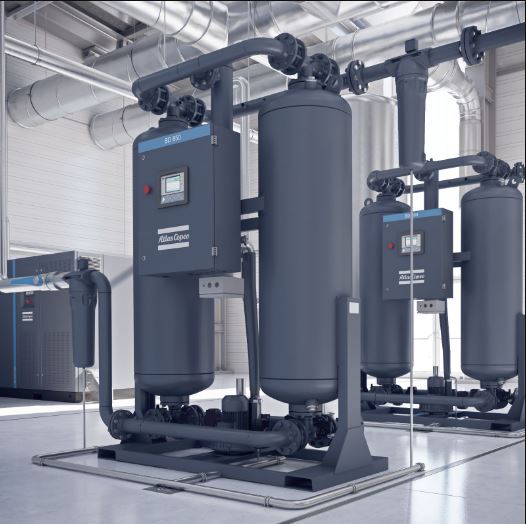 | Desiccant Type Air Dryer Dry and clean compressed air is essential for a broad range of industrial applications. View product → |
 | Refrigerated Air Dryer The air that leaves a compressor reaches 100% humidity. Aftercoolers and drains are the first line of defense against water in your system. View product → |
Protecting the dryer from the failures it cannot fix
A dryer cannot remove failures created upstream. Liquid water entering the vessel wets desiccant and can saturate it early; compressor oil coats adsorption surfaces and reduces capacity. Failed drains pass water downstream, while inadequate coalescing filtration lets contaminants reach the desiccant beds. The result is moisture breakthrough, valve faults and premature media replacement.
Use these installation checks:
- Fit liquid separation and coalescing filters rated for the maximum flow and inlet pressure.
- Install automatic condensate drains and confirm that each one opens during operation.
- Check compressor oil carryover; a dryer cannot restore desiccant fouled by oil.
- Measure pressure drop across the dryer and filters at design flow and with loaded filter elements.
An oversized dryer increases capital cost and can waste purge air when demand remains far below its rated flow. An undersized dryer reaches saturation early, raises pressure drop and delivers wet air during peak demand.
Operating above the rated inlet temperature, below the design pressure, beyond maximum flow or at a lower required pressure dew point causes the same failures, even if the nameplate capacity looks adequate.
The practical desiccant dryer benefits in Bangalore depend on this integration. For dry compressed air manufacturing, match the package to peak demand, receiver placement, compressor sequencing and the specified pressure dew point—not monsoon humidity alone. Check pressure loss because every extra bar can force higher compressor discharge pressure and increase energy use.
Frequently asked questions
How does moisture cause manufacturing production failures?
Moisture corrodes pipework, damages pneumatic instruments, freezes in expansion points, contaminates products, and disrupts processes that require dry compressed air.
When is a desiccant dryer worth its extra cost?
Choose one when your process needs a pressure dew point below the capability of refrigerated drying, or when moisture damage costs more than the added equipment and operating expense.
How do heatless, heated, blower and zero-purge dryers differ?
Heatless dryers use compressed air for regeneration; heated dryers add external heat; blower dryers use a separate blower; zero-purge designs avoid losing treated compressed air during regeneration.
How should you size an Atlas Copco dryer for Bangalore conditions?
Use the required flow, inlet pressure, inlet temperature, pressure dew point, ambient temperature, and altitude, then apply the manufacturer’s correction factors for the selected operating conditions.